
Should you trade Jersey City, Hoboken, or NYC for the Montclair area?
If you've lived in Downtown Jersey City, Hoboken, or Manhattan for a few years, you already know the rhythm: elevator to the street, coffee on the corner, PATH or ferry, and a 20-minute door to desk commute. Eventually, though, a lot of my clients hit an inflection point a baby on the way, a home office that's swallowed the second bedroom, or simply the itch for a backyard and a quieter street. The Montclair area — Montclair proper, Bloomfield, Glen Ridge, and Verona is one of the most common landing spots I help clients evaluate. It's close enough to stay connected to the city, but it's a genuinely different way of living.
This isn't a "the suburbs are better" post. It's an honest look at what you gain and what you give up, town by town, so you can decide with clear eyes.
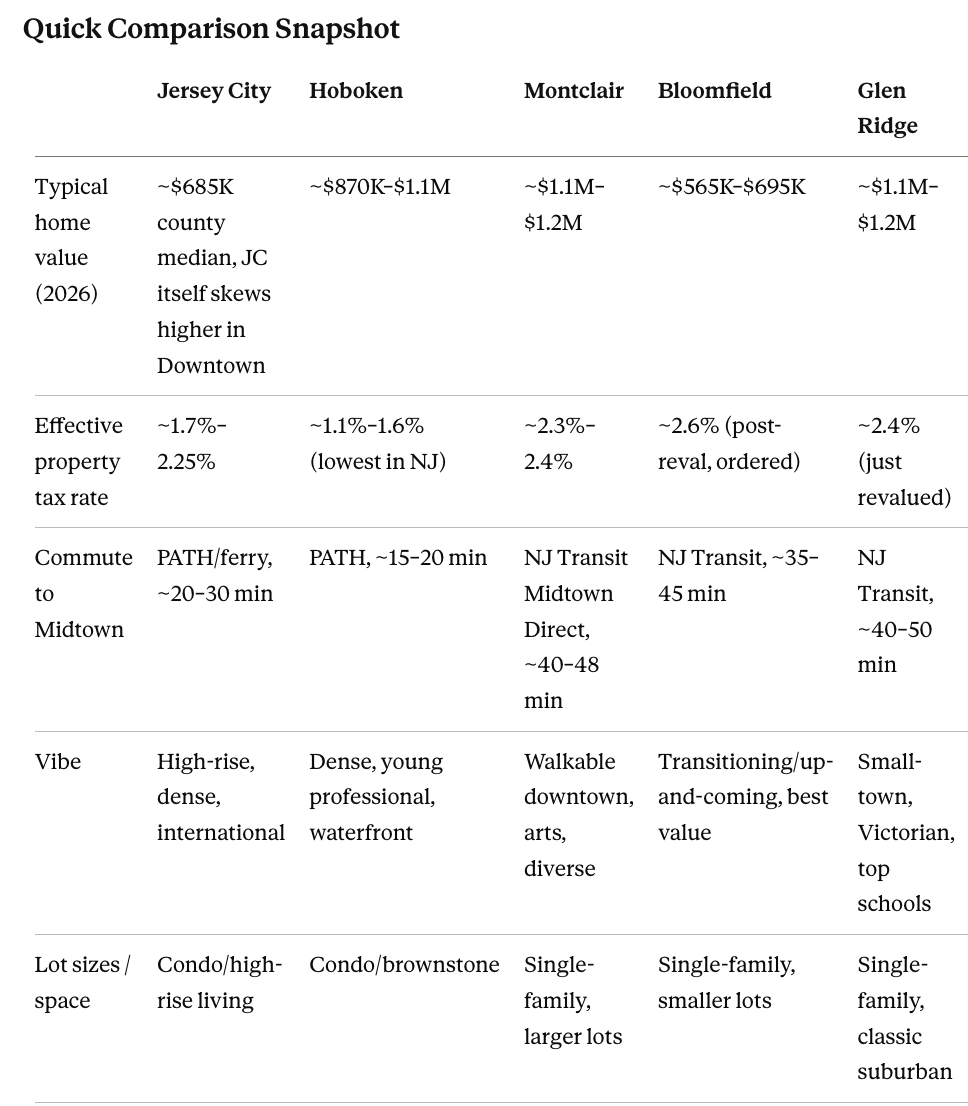
Figures are approximate as of mid-2026, pulled from a mix of MLS, Zillow, Redfin, and county tax board data, and they move constantly — especially right now, since Montclair and Bloomfield both have property tax revaluations in progress that will reset assessments over the next couple of years. Always confirm current numbers on a specific property before making a decision.
The Case FOR Making the Move
1. You get dramatically more physical space for the same or less money. This is usually the number one driver. A budget that buys 900 square feet in a Downtown JC high rise or a one bedroom in Hoboken can buy a 2,000+ square foot single-family home with a yard in Bloomfield or Verona, and a similarly-appointed Colonial with real land in Glen Ridge or parts of Montclair. If home office space, a nursery, or a yard for a dog is on your list, this is where the math starts working in your favor.
2. The schools are a genuine draw, not just a marketing line. Glen Ridge and Montclair in particular are known for strong, well-resourced public schools, and that reputation is part of why home values there have held up so well. If you're planning a family or already have school-age kids, this is often the single biggest financial and lifestyle argument for the move private school tuition in NYC or top JC-area options can rival or exceed the tax premium you'd pay in Essex County.
3. Montclair gives you "small city" energy without giving up culture. Montclair has a genuinely walkable downtown, a well-regarded farmers market, an art museum, an independent film theater, live music venues, and a restaurant scene that punches well above its population size. It's the closest thing in this group to replicating a JC/Hoboken lifestyle on a quieter, tree-lined scale. If losing "stuff to do within walking distance" is your biggest fear about leaving the city, Montclair addresses it more than the other three towns.
4. Bloomfield is the value play, and it's changing fast. Bloomfield has historically been the most affordable of the four, and it's in the middle of real transition new transit-oriented development, breweries, and restaurants opening near the train stations, and a meaningfully lower entry price than its neighbors. For buyers priced out of Montclair or Glen Ridge but who still want the train line, good bones, and upside, Bloomfield is worth serious consideration. The tradeoff: it's also one of the towns currently in line for a property tax revaluation, so budget with some cushion.
5. Glen Ridge and Verona offer a real "small town" reset. If part of what's driving you out of JC/Hoboken/NYC is density itself noise, crowds, traffic, the feeling of being one of a million Glen Ridge and Verona are the antidote. Glen Ridge is a tiny, historic, walkable Victorian village of under a square mile. Verona has a genuine town-green feel, plus Verona Park's lake, walking paths, and boathouse. Both feel more like a step back in time than a suburb of a suburb.
6. You keep real rail access to Manhattan. Unlike a lot of NJ suburbs that require driving to a train station and transferring, all four towns sit on or very near the Montclair-Boonton Line, which offers Midtown Direct service straight into Penn Station as well as Hoboken-bound trains that connect to PATH for Lower Manhattan or Downtown Jersey City commuters. It's not a 15-minute PATH ride, but it's a one-seat trip if your office is near Penn Station, and local jitney services in several of these towns solve the "last mile" to the station.
7. Green space is abundant and close. Brookdale Park (Bloomfield/Montclair), Verona Park, the South Mountain Reservation, and Eagle Rock Reservation with its Manhattan skyline view are all within a short drive or bike ride. If your current outdoor options are a rooftop deck and Hamilton Park, this is a meaningful quality-of-life upgrade.
The Case AGAINST Making the Move
1. Property taxes are the single biggest financial gut-check, and they're rising further. This is the trade-off I spend the most time walking clients through. Hoboken and Jersey City residents currently enjoy some of the lowest effective property tax rates in Hudson County (although as of this writing there are upcoming scheduled property tax hikes for both Jersey City and Hoboken). Hoboken in particular is often cited as having the lowest effective rate in the entire state. Essex County, by contrast, consistently ranks among the highest-taxed counties in New Jersey, and Glen Ridge, Montclair, and Bloomfield have all appeared on statewide "highest average tax bill" lists. To make it more complicated right now: Verona, Glen Ridge, and Cedar Grove just completed property tax revaluations for 2026, and Montclair and Bloomfield both have revaluations ordered and pending through 2028 meaning assessments (and likely bills) in those two towns are likely to shift, probably upward, in the next few years. Budget for the tax bill you'll actually pay after a reval, not just today's number.
2. The commute gets meaningfully longer and less flexible. Even the best-case Midtown Direct ride from Montclair runs 40-48 minutes to Penn Station and it doesn’t run on weekends, versus a 15-20 minute PATH ride from Hoboken and Jersey City. And critically, it's peak-hour optimized: off-peak, weekend, and reverse-commute service on the Montclair-Boonton Line is noticeably thinner than PATH's near-constant frequency. If your job has unpredictable hours, requires frequent late nights in the city, or you value being able to hop a train home from Manhattan at 11pm without checking a schedule, this is a real lifestyle change, not just a longer number.
3. You trade walkable urbanism for car dependency, even in the "walkable" towns. Montclair's downtown is genuinely walkable, but daily life in all four towns groceries, gym, pediatrician, weekend errands assumes a car in a way that JC and Hoboken simply don't. Two-car households become the norm rather than the exception, which adds real monthly cost (insurance, gas, maintenance, parking at some train stations) that's easy to underestimate when you're pricing "just the mortgage."
4. The market is extremely competitive right now, which cuts both ways. Montclair in particular has been running hot with homes going pending in as little as 11-49 days depending on the data source, with a meaningful share of homes selling well above asking price. That's good news if you're already a homeowner elsewhere selling into this market, but it means buyers moving into Montclair need to be financially and emotionally ready for competitive offer situations, potentially waived contingencies, and fast decision making the opposite of a leisurely house-hunting experience. The condo marketing doesn’t encounter as many fierce bidding wars unless you are looking to purchase a 3 bedroom or more.
5. You lose density-driven convenience and 24/7 texture. Late-night food delivery options, a bodega on every corner, a subway or PATH that runs all night, the ability to not own a car at all these are real, quantifiable quality-of-life features of JC/Hoboken/NYC living that don't fully exist in Essex County suburbs, even in a town as vibrant as Montclair. If a huge part of your identity is tied to spontaneous, dense urban life, it's worth being honest with yourself about how much you'll miss it.
6. Exiting is slower and less liquid. Selling a suburban single-family home typically takes longer and involves more variables (inspections, well/septic where applicable, more idiosyncratic renovations) than selling a condo in a building with dozens of comparable recent sales. If you value the ability to relocate again on short notice for a job or life change, that flexibility is generally higher in a JC or Hoboken condo than in a Montclair area single-family home.
7. New Jersey school-funding-linked tax exposure works both ways. The flip side of "great schools" is that a large share of your property tax bill is directly funding them, and that number moves with local school budgets, not just municipal ones. It's a fair trade for many families, but it means your tax bill has more moving parts and more local political exposure than in a city where school funding is structured differently.
Which Town Fits Which Kind of Buyer?
Montclair — best for buyers who want the most "city-adjacent" suburban experience: walkable downtown, restaurants, arts, diversity, and the shortest realistic commute of the four. Expect to pay the most and compete the hardest.
Glen Ridge — best for buyers prioritizing schools and a tight-knit, classic small-town feel above all else, and who are comfortable with a very small inventory of homes (it's under a square mile). Also very competitive market.
Verona — best for buyers who want a quieter, more residential feel with a real town-park anchor, at a meaningfully lower price point than Montclair or Glen Ridge, with schools that are still well-regarded.
Bloomfield — best for buyers who are price-sensitive, want train access, and are comfortable buying into a town that's mid-transition meaning more upside, but also more variability block to block, plus a pending tax revaluation to factor into your budget.
The Bottom Line
There's no universally "right" answer here it genuinely depends on what you're optimizing for. If your priorities are space, schools, and a slower pace, and you can absorb a possibly higher property tax bill and a longer, less-flexible commute, the Montclair area delivers real, tangible upgrades to daily life. If PATH-speed access to Manhattan, walkable density at all hours, preference of new construction homes and slightly better tax efficiency matter more to you than square footage, staying in Jersey City or Hoboken or looking at the Jersey City Heights newer developments may still be the smarter move.
I've helped clients make this exact move in both directions, and the right call almost always comes down to running your specific numbers: your actual commute pattern, your realistic five year home value picture, and an honest tax projection that accounts for the revaluations currently working their way through Essex County. If you want to run those numbers on your specific situation including a side-by-side on tax bills post-reval reach out and I'll put together a comparison built around your actual budget and priorities. Check out my neighborhood guides linked below