NJ Towns Where New Yorkers Don’t Just Survive They Thrive
New Jersey Real Estate Guide · 2026
Across the Hudson,
Not Across the World
Eight New Jersey towns where former New Yorkers don't just survive — they thrive. Space, schools, culture, and a train that still gets you to the city.
New York will always be New York. But at some point — a growing family, a first yard, the hundredth time paying $4,500 for 700 square feet — the math changes. New Jersey isn't a consolation prize. The towns in this guide offer farmers markets, serious restaurants, arts venues, and parks that rival anything in the outer boroughs. Plus a train that drops you in Midtown before your coffee gets cold.
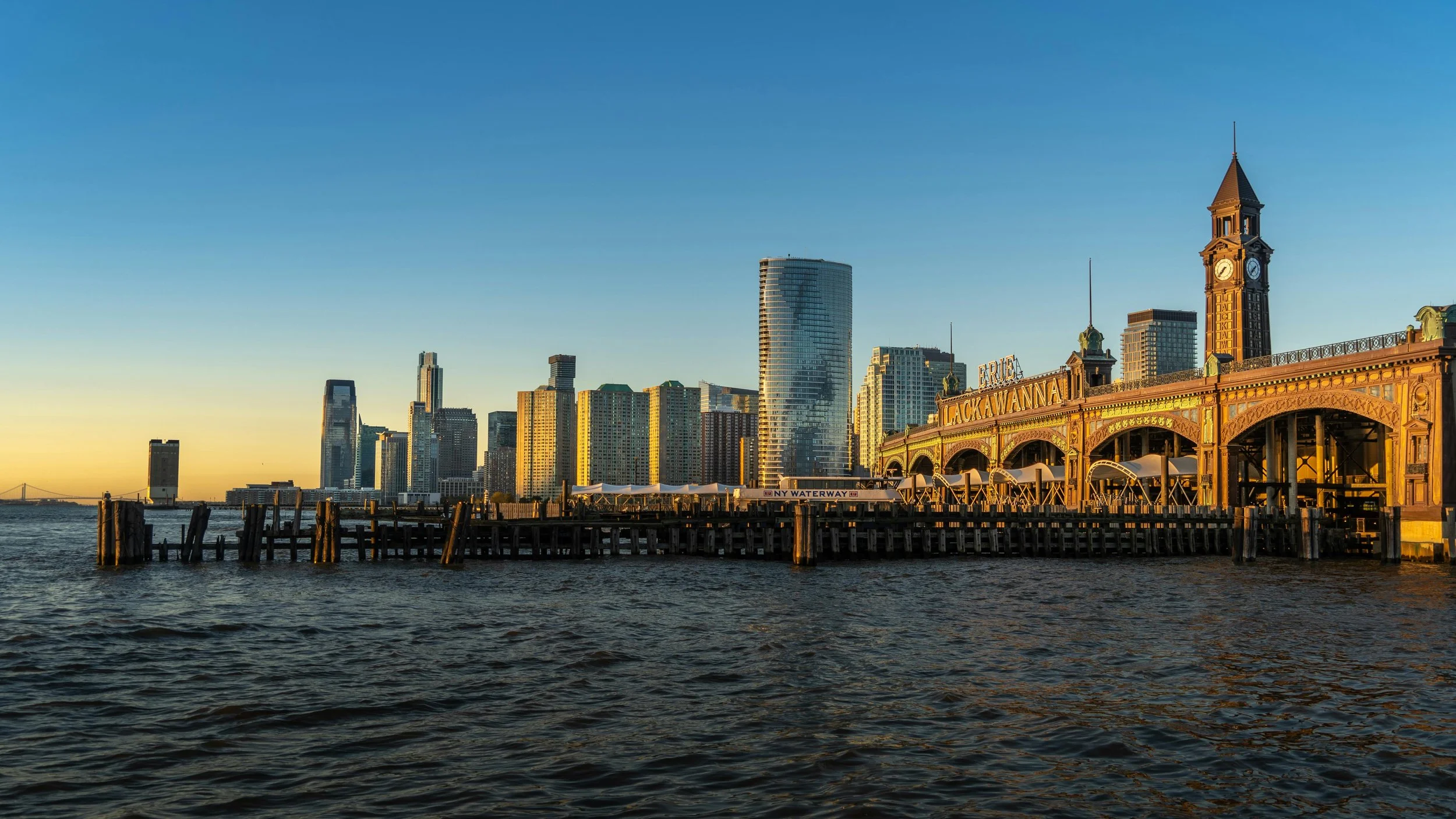
Two PATH lines, 24/7 service, peak frequency every 3–5 minutes. The NJ Waterway ferry offers a scenic Hudson crossing. Monthly PATH pass: ~$89.
The most urban market in NJ. Condos and brownstone conversions dominate. Expect $500K–$800K for a 1–2BR; townhouses and larger units push $1M+. Very limited inventory drives competition.
Washington Street buzzes with independent cafés, wine bars, and serious restaurants. Anthony David's and Amanda's Restaurant are institutions. The brunch scene rivals the West Village.
Pier A Park and the Hudson River Waterfront Walkway offer Manhattan skyline views with actual grass. Stevens Institute's campus green adds to the park feel of the north end.
Public schools are solid, not spectacular. Hoboken Charter School and the Stevens Cooperative School are popular alternatives. Families frequently consider private options in the area.
Mile Square Theatre, Hoboken Historical Museum, and a strong live music tradition — Frank Sinatra's hometown wears its cultural heritage proudly. Regular arts events at the Pier.
Hoboken is the softest landing for New Yorkers not ready to fully commit to "the suburbs." It is dense, walkable, and loud in the best way. The tradeoff: smaller spaces, the most expensive per-square-foot prices outside Jersey City, and schools that don't match the suburban competition. Best for city people who want a yard someday — just not yet.
Grove Street and Exchange Place PATH stations are among the system's busiest. Every 4–6 minutes at rush hour. The Hudson-Bergen Light Rail connects neighborhoods internally.
JC is a tale of multiple markets. Downtown Paulus Hook/Hamilton Park: $700K–$1.2M+. The Heights: $400K–$700K for brownstones and multifamilies. Bergen-Lafayette: entry points from $350K. The range is NJ's widest.
Newark Avenue is NJ's most compelling restaurant row. Porta (wood-fired pizza), White Star, and a wave of independent coffee shops give it a Williamsburg-in-its-prime energy. Deeply international food scene.
Liberty State Park is the crown jewel — 1,200 acres with direct views of the Statue of Liberty and Ellis Island. Lincoln Park offers tennis, an ice rink, and open meadows that feel genuinely suburban.
Variable but improving. The STEM magnet and charter sector (McNair Academic, which ranks nationally) draws families strategically. District schools vary considerably by neighborhood — research carefully.
The Mana Contemporary arts complex is a genuine cultural institution housing museum-quality shows. The Historic Paulus Hook neighborhood, LITM music venue, and a thriving mural scene add real texture.
Jersey City is the best value proposition in the New York metro area for buyers who still want urban density, cultural energy, and a short commute. The school situation requires homework, but the combination of price range, transit, restaurants, and Liberty State Park makes it hard to beat for young families who aren't ready to trade sidewalks for driveways.
Four stations on the Montclair-Boonton Line. Monthly pass runs ~$250–$280. The DeCamp bus is beloved by those who prefer a seat guarantee and skip-the-station convenience.
Beautiful Victorian, Tudor, and Colonial homes dominate. $800K is a starter; $1.1M is the average; properties near Upper Montclair or in the best school zones routinely hit $1.5M+. Property taxes are high (~$20K–$28K/yr).
Excellent independent coffee culture: Spoonfed, Montclair Bread Company, and a Saturday farmers market at Walnut Street that doubles as a social institution. Dining ranges from farm-to-table to serious sushi and Korean BBQ.
Brookdale Park's rose garden and duck pond rival anything in suburban New England. Edgemont Park, the Eagle Rock Reservation, and direct access to the South Mountain Reservation give hikers and runners real options.
Montclair public schools are excellent and nationally recognized for their magnet structure and diversity. Montclair Kimberley Academy (private, PreK–12) is one of NJ's top independent schools. Arts programming is exceptional across all levels.
Montclair Art Museum, Wellmont Theater (major touring acts), Montclair Film Festival (nationally recognized), Montclair State University — this town punches far above its population weight. Writers, musicians, and Broadway performers are your neighbors.
Montclair is the gold standard of NJ suburb-with-a-soul. If you loved Park Slope or Fort Greene and want to stay in that same cultural register, this is your town. The price premium is real — budget $1M+ and expect bidding wars — but you're buying into one of the most dynamic and intellectually alive communities in the tri-state area. The 45-minute commute to Penn Station is the main tradeoff.
Midtown Direct one-seat ride to Penn Station is the commuter's dream. Monthly pass ~$208. A community jitney connects homes to the station for $25/month — a throwback NJ amenity.
Maplewood runs slightly lower (~$900K avg) than South Orange (~$1.05M) due to home size differences. Beautiful Colonial, Victorian, and Tudor stock throughout. Entry points around $650K for smaller homes. Multiple-bid situations remain common.
Springfield Avenue in Maplewood and South Orange's Village have charming, walkable downtown strips. Lots of independent cafés, a beloved wine shop, and restaurants that punch above their size. A Brooklyn-transplant energy that doesn't try too hard.
Maplewood's town pool is a summer institution. Memorial Park and the shared access to the Rahway River Reservation and South Mountain Reservation give both towns easy access to real trails and green space.
The South Orange-Maplewood School District is one of NJ's most celebrated for its intentional diversity model. Columbia High School produces National Merit Scholars alongside robust arts and music programs. Math and reading scores outperform state averages.
SOPAC (South Orange Performing Arts Center) hosts national touring acts and film screenings in a stunning converted historic building. Seton Hall University adds a university-town dimension to South Orange. Strong community theater and arts programming.
SOMA — as the locals call it — hits a near-perfect balance of community, schools, transit, and price relative to Montclair. The towns attract former Brooklynites who have become genuinely evangelical about suburban life. Diverse, progressive, and proudly eclectic, with a famous community ethos. If you're buying for schools and community as much as the house itself, this is arguably the best value in Essex County.
Midtown Direct express service — no transfers. Monthly pass ~$260. Hybrid-work commuters find this schedule highly manageable at 3–4 days per week. The station is a short walk from downtown.
Summit is firmly in the premium tier. $1M gets you into the market; $1.5M–$2M buys a handsome Colonial on a good street. True estate properties and new construction push $3M+. Property taxes average $20K–$30K/yr.
Beautifully curated downtown with upscale independent restaurants, wine bars, and boutiques. Roots Steakhouse, Ninety Acres catering concept, and a well-regarded weekend brunch scene. Feels refined without being stuffy.
Reeves-Reed Arboretum (a genuine horticultural treasure), the Watchung Reservation within reach, and well-maintained town parks. Summit's topography — it sits on the Watchung ridge — gives it a distinctly elevated, wooded feel.
Summit Public Schools consistently rank in the top 5% of NJ. Summit High School sends graduates to Ivy League and top universities at an impressive rate. AP course selection is deep; arts and athletics are both funded properly.
The Summit Playhouse is a cherished community theater. The New Jersey Center for Visual Arts (NJCVA) offers classes and exhibitions. Smaller and quieter than Montclair's arts scene, but well-curated and community-supported.
Summit is where NYC professionals land when they're optimizing for schools and square footage and have the budget to do it right. It's not cheap — in any dimension — but the quality of life return is legitimate. The schools are among NJ's best, the downtown is genuinely lovely, and the express train keeps the city accessible enough for professionals going in three or four days a week.
The longer commute is Ridgewood's only real weak point. Many residents embrace it as reading/decompression time. Monthly pass ~$230. Ample parking at the station.
Stately Colonials, Tudors, and Craftsmans on tree-lined streets. Entry points around $750K for smaller homes; $1M–$1.5M is the sweet spot for 4BR properties. The school premium is baked into every price.
Ridgewood's downtown (The Ridgewood Village) is a textbook pretty American Main Street — independent boutiques, excellent bakeries, and a farmers market. Restaurant quality is high; the weekend dining scene draws from surrounding towns.
Graydon Pool is a beloved community institution — a natural swimming lake that families plan their summers around. Ridgewood's park system is well-funded; Vander Beck Preserve adds hiking trails and stream access.
Ridgewood Public Schools are the primary reason people move here. Ridgewood High School consistently ranks in the top 3% of NJ and top 1% nationally by some metrics. Exceptional AP, IB, and arts programs. Class sizes are manageable.
Strong community arts programming, youth theater, and a well-regarded public library that functions as a cultural hub. Proximity to Bergen Performing Arts Center (BergenPAC) in Englewood — one of NJ's premier mid-size venues — extends the cultural offering significantly.
Ridgewood is for buyers who are consciously making the schools-first decision and accepting the longer commute as part of that equation. It is objectively one of NJ's finest public school districts, and the town itself is classically beautiful. Those who move here tend to stay — resale demand from within the community is always high. The 55-minute commute works best for hybrid schedules.
One of the fastest commutes in NJ — the ferry terminal sits at the base of the bluffs. NJ Transit buses through the Lincoln Tunnel are equally fast. No PATH, but you rarely miss it.
Waterfront high-rises offer luxury condos with full amenity packages ($600K–$1.5M+). The bluff-top residential streets feature classic single-family homes at more modest prices ($450K–$750K). Underrated relative to Hoboken.
Smaller dining scene than Hoboken or JC, but growing. Ruth's Chris and Chart House Weehawken anchor the waterfront dining. Local cafés and restaurants on Park Avenue serve the residential community quietly and well.
Waterfront Park and the Hamilton Park (the Aaron Burr/Alexander Hamilton dueling grounds — yes, really) are beloved local spaces. The Palisades Cliffs walking path offers unbeatable skyline views. Lincoln Harbor Park fronts the Hudson.
Weehawken schools are solid for a small township but don't compete with the Essex County destinations on this list. Families typically stay shorter-term before moving further into NJ when children approach school age.
Quiet on its own, but proximity to Hoboken and Jersey City means culture is always nearby. The historic significance of the Palisades and Hamilton's legacy give the town genuine character. The Hoboken arts scene is a 10-minute walk.
Weehawken is Hoboken's quieter, slightly more residential sibling — with better views and lower prices. It suits professionals and couples who want the proximity without the Washington Street crowds. It is not an ideal long-term family destination if school quality is the priority, but as a first-move-out-of-the-city destination, it is almost impossible to fault. The skyline view from the bluffs never gets old.
Glen Ridge's train station is a turn-of-the-century gem. Monthly pass ~$169. A community jitney ($25/month) handles the station connection. Walk time from many homes to the platform is under 10 minutes.
Beautiful, large historic homes — six-bedroom Tudors and Colonials at $950K–$1.3M offer extraordinary value versus comparable properties in Montclair. Mostly owner-occupied; very low rental inventory. The town is almost entirely residential.
Glen Ridge has almost no downtown to speak of — but Montclair's four business districts (and their excellent restaurants and cafés) are a 5-minute drive or bike ride away. This is a feature, not a bug, for those who want a quiet street and outsourced dining.
Glen Ridge is architecturally park-like in its own right — the historic district streets feel like a living museum of early American residential design. Shared access to Brookdale Park and the South Mountain Reservation via Montclair.
Glen Ridge Public Schools serve a very small district with an intensely community-supported culture. Class sizes are among NJ's smallest; parent involvement is high. Glen Ridge High School sends graduates to selective colleges at strong rates for its size.
The town itself is culturally quiet, but benefits entirely from Montclair's arts infrastructure next door. Residents describe it as getting Montclair's culture with none of the foot traffic. The community itself — writers, academics, musicians — brings the arts home.
Glen Ridge is the insider's pick — a tiny, architecturally stunning, fiercely community-minded borough that offers a faster train to Penn Station than Montclair, similar-quality schools at a slightly lower price point, and a sense of small-town intimacy that larger suburbs simply cannot replicate. If you've done the tour of Essex County towns and keep finding everything slightly too much, Glen Ridge is the answer.
All eight towns at a glance
| Town | Avg. Price | Commute to NYC | Schools | Walkability | Arts Scene | Best Fit |
|---|---|---|---|---|---|---|
| Hoboken | ~$700K | 12 min PATH | Moderate | Excellent | Strong | Young professionals |
| Jersey City | $350K–$1M+ | 8–15 min PATH | Variable | Excellent | Strong | Urban families, investors |
| Montclair | ~$1.1M | 45 min NJ Transit | Excellent | Very good | Best in class | Creative families |
| Maplewood/SO | $900K–$1.05M | 35–40 min direct | Excellent | Good | Strong | Families, diversity seekers |
| Summit | ~$1.35M | 47 min express | Top 5% NJ | Good | Moderate | High-earning professionals |
| Ridgewood | ~$1.1M | 55 min NJ Transit | Top 3% NJ | Good | Moderate | School-first families |
| Weehawken | ~$650K | 10 min ferry/bus | Moderate | Good | Moderate | Couples, short-term starters |
| Glen Ridge | ~$950K | 32 min direct | Very good | Moderate | Borrowed (Montclair) | Intimate community seekers |